|
Rainsong's Animals
Rainsong Wildlife Sanctuary has already had many wild animals pass through. Some have been healed and released. Many we could not save, others
are still with us, due to some permanent handicap that prevents their being released.
Click Release List for a list of the animals that we have successfully rescued and released so far.
Click Extinct Animals for a list of animals that are extinct or nearly extinct in our area.
Click here to visit our Rare Bird Release Program page, for details and pictures.
~~~~~~~~~~~~~~~~~~~~~~~~
'Tarzan' the white-face monkey
September 2007
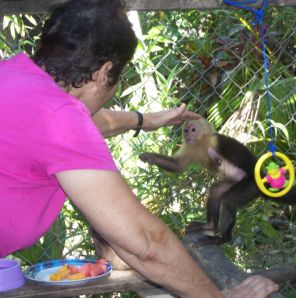 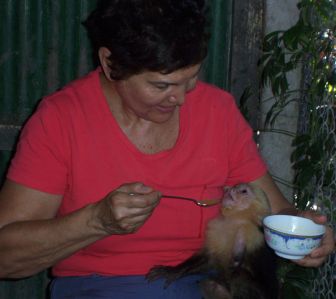
Bonnie with Tarzan on his first day at Rainsong
As an infant, Tarzan witnessed his mother being murdered by ticos, so they could take him as a pet. They quickly tired of caring for him, and they thought the easiest solution was to release him in the woods behind their house, outside Cobano in 'la Tranquilidad'.
An infant monkey with no troop to defend him, he had ZERO chance to survive.
That same afternoon, a troop of howler monkeys attacked him, but other neighbors nearby heard the commotion, and came running to rescue him from the howler monkey troop.
They then rushed him to the vet in Cobano.
Tarzan was shredded from the attack.
The vet had to amputate his left arm.
He was in recuperation for 6 weeks at the vet's clinic in Cobano, then he was sent to Rainsong.
Now he can never be released to have a normal monkey's life in the forest.
(We know so many details about the circumstances around Tarzan's rescue because 2 children from the families involved actually visited the rescue center about a year later, with a group from the elementary school in Cobano, and they told us all the details).
Even after such a traumatic start in life, Tarzan seems to have found happiness here at Rainsong with all his volunteer friends.
Tarzan is one of the most popular residents at the rescue center.
Once we build the jungle habitat on the Sanctuary, he can go to live there in semi-freedom.
For now, he seems very content to get out every morning for a romp in the bushes at the Rainsong quinta.
He's very sweet and playful, very intelligent. We all love him very much !
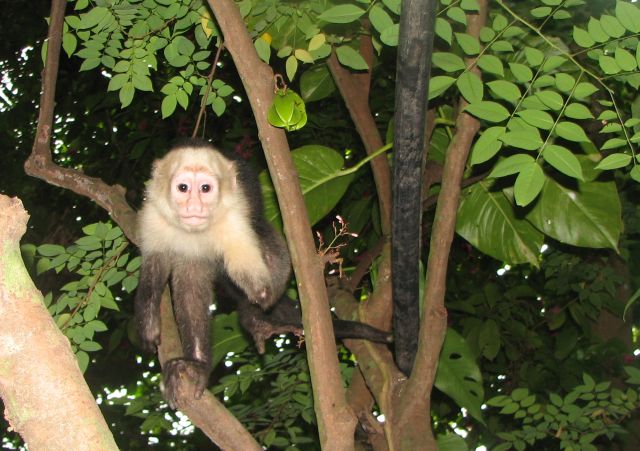
Tarzan on an outing in the canopy at Rainsong.
~~~~~~~
Howler Monkeys
June 2009
To date, we have rescued, treated, & released 3 adult howler monkeys, all females.
Several others we could not save.
All were victims of electrocution on the Costa Rican government's un-insulated electric lines.
We also have had many babies brought to us, probably over 10 in the past few years.
So far we've been able to save only one infant.
The majority were suffering from injuries from electrocution while clinging to their mother.
Also, some were attacked by dogs when they fell from the lines or occasionally from the trees, others were hit by cars while being carried by their mother.
'Mona Lisa' the tail-less wonder !
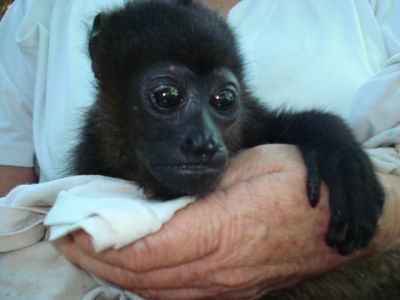
mona was about 3 weeks old when brought to Rainsong.
She was the victim of an 'alpha coup', when a new alpha leader takes over the troop and harem of another male.
Sometimes, not always, the new male will go around and grab the baby monkeys (usually the males), wrench their necks and throw them down to the ground.
Eliminating future competition.
mona was found lying in the brush, covered with flies and maggots, with terrible wounds across her back. We are surprised the bites didn't break her tiny lil back. The vet said she had probably been lying there for 3 or 4 days.
Her tail had been bitten almost completely off, and the vet had to amputate it.
The first 2 months she was in constant intensive care.
She was terribly traumatized, and very resistant to caretaking.
She continually bit us ferociously, and only mary and coral tolerated the biting in order to care for her.
She kept jumping out of our grasp and taking off into the canopy of the trees at the Rainsong quinta.
We finally had to put a harness on her so that we could control her more easily.
Now that she has adapted to human care, she enjoys outings into the trees at Rainsong, and she is much sweeter and loving now.
Almost 5 months later, she now has even begun to smile for us !
She also gives us kisses and hugs !
She is a joy, and we all love her !
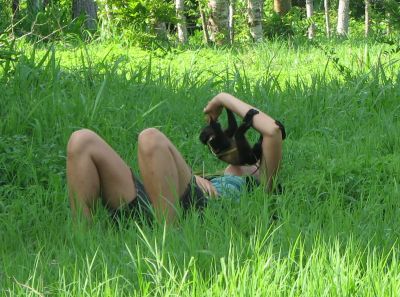
Mona and Coral hard at work.
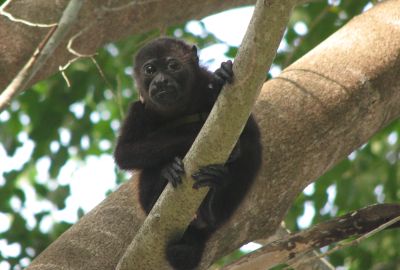
Mona content in the trees at Rainsong.
'Anti' the Anteater
June 2009
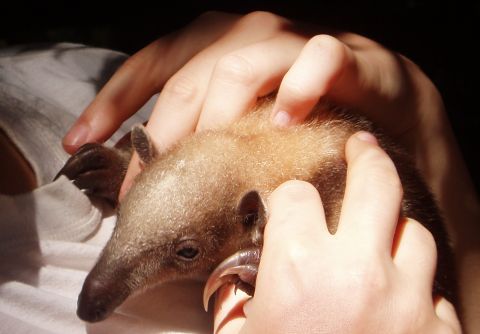
Our anti came to us the day she was born! She fell off her mother's back while her mom was being chased by a pack of dogs in Santiago de San Marten, near Manzanillo. Her mother was killed by the dogs. The local people nearby managed to save tiny anti from the dogs just in time.
She came to us unharmed, and her eyes were even still closed !
It was a daunting task caring for this perfect lil anteater, and we scrambled to educate ourselves so that we could provide for her correctly. Anteaters need the formic acid from the ants they eat for their intestinal systems to function properly.
Babies receive the needed properties in their mother's milk.
So we collected ants and blended them with goat's milk and baby formula, until anti learned to hunt for ants on her own.
Now that she's a big girl, the volunteers take anti out into the bush on anthunts 3 times a day.
She will grow to be the size of a large german shepherd dog !
Altho the C.R. government doesn't allow infant wildlife to ever be released back into the wilderness, we plan to release her in our jungle habitat once it is built.
She is a favorite resident at Rainsong, we all love her !
She's tender, sweet, loving, and a bit stubborn. Strangely, her little snorts of complaint when she doesn't always get her way resemble the bleatings of a goat !
Anteaters are being wiped out in our area by roaming domestic dogs !
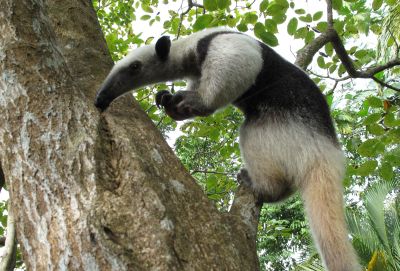
Anti in the trees at Rainsong.
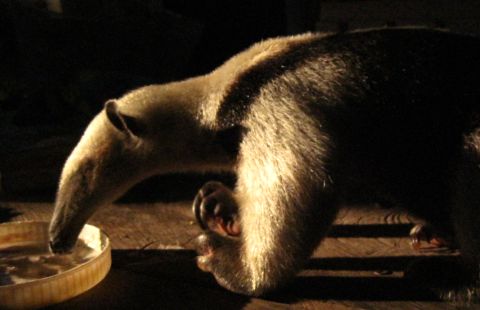
Anti in ecstasy at the dinner table!
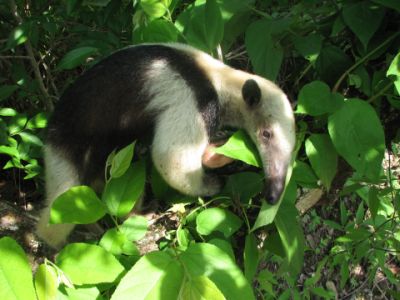
Anti on an ant hunt.
'Kinky' the Kinkajou / Potos Flavus/ 'Martilla' - Costa Rica / 'Honey Bear' - common nickname
June 2009
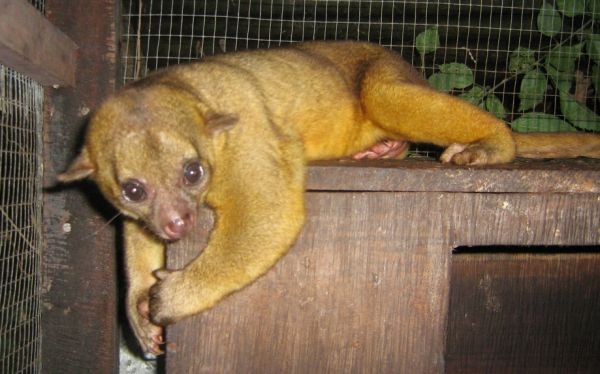
Somewhat common in some tropical forest areas of Costa Rica, the kinkajou is overall an almost unknown species. Kin to the coati mundis, olingos, and raccoon family,, this elusive nocturnal mammal lives in family groups in gallery forests, rarely coming down from the canopy.
The kinkajou is the favorite prey of the ocelot.
Almost extinct in our area, after having been heavily hunted for their soft skins in past decades (for padding horse saddles), the remaining populations in our area have been wiped out in just the last decade by loss of habitat, and electrocution on the Costa Rican government's electric lines and transformers.
We've tried to save the 10 or so that have come to the rescue center in the last few years, but all but one were too badly burned, or had broken their back in the fall off the electric lines after the shock, or were too dehydrated and emaciated after languishing in pain for days in the brush, too hurt to crawl for help.
Just a few years ago we would see them often, dead, hanging off the electric lines near montezuma, and other towns nearby.
None of the local ticos that have visited the rescue center have ever seen one alive.
Sad, but too true.
Our 'Kinky' is very special amongst all wildlife. After dropping off the electric lines, then agonizing for days, barely able to crawl, she climbed up into a windowsill seeking help from humans!
Near death, she was rushed to the vet in Cobano, and then sent to Rainsong.
She was burned over almost half of her body, and severely dehydrated and starved.
In some parts of her body she had been burned down to raw muscle, no hair nor skin.
Several toes had been burned off, and her right knee was destroyed.
During almost 2 months of enduring burn bandage dressings being changed twice a day,
she never once became agitated or struggled. She appreciated our efforts to save her from death.
Her skin and hair grew back quickly, but she never regained use of her right knee, the entry point of the jolt.
We built a comfortable habitat house just for her. We will release her into the jungle habitat in the Sanctuary, as soon as we acquire funding for the construction of it.
Meanwhile, we hope to be enabled to save a male kinkajou soon, so she's no longer alone.
When she's in heat, her calls sound more like a bird's !
She is a favorite amongst the volunteers, we all love her dearly !
Chaitanya and Durga
Ocelots
June 2009
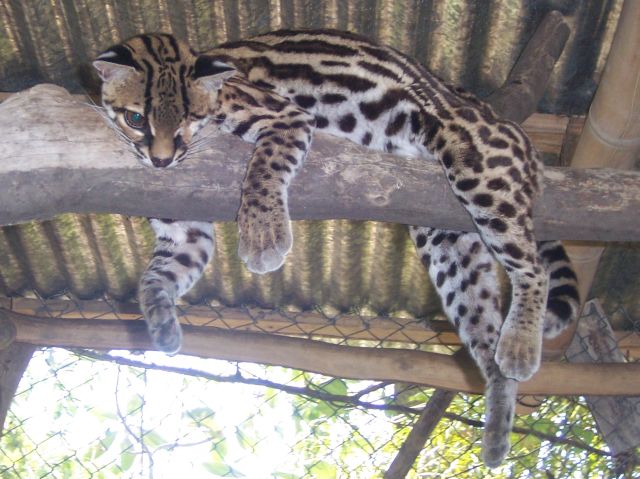
Chaitanya in lounge mode
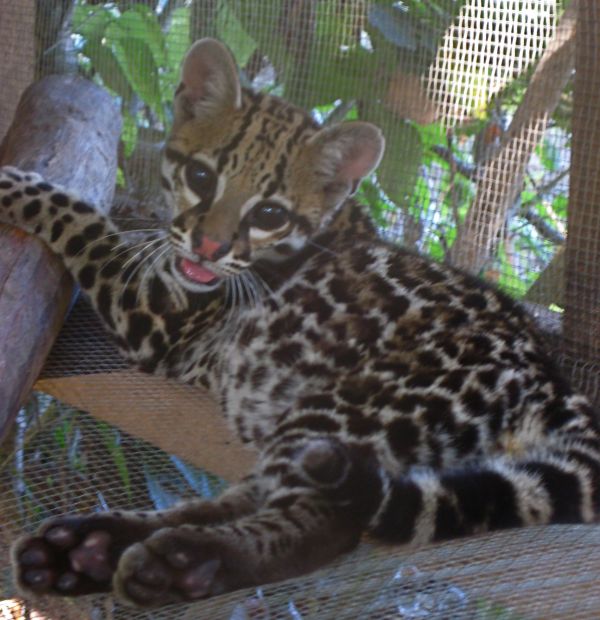
Durga at ease after being rescued from poachers
After their arrival at Rainsong, we were told that both our wildcats are margay, but once we began to research online the margay cat for caretaking knowledge, we discovered that they are both actually ocelots.
Wild cats are so rare that even the biologists and vets here can't identify which species they are !
Both our cats are victims of the hide trade, this is HIDEOUS !!!
Chaitanya, a juvenile male was hit by a car on the road outside Curu Reserve near Paquera, then almost skinned alive by the driver.
He was rescued by the occupants of the car behind (after a fistfight to wrest him from the skinner), and rushed to the vet.
The impact had knocked his left eye out of his head, and it had to be removed.
He also suffered severe head trauma.
Miraculously, he survived surgery, and was sent to Rainsong.
He can never be released, due to the loss of depth perception, he would surely starve to death.
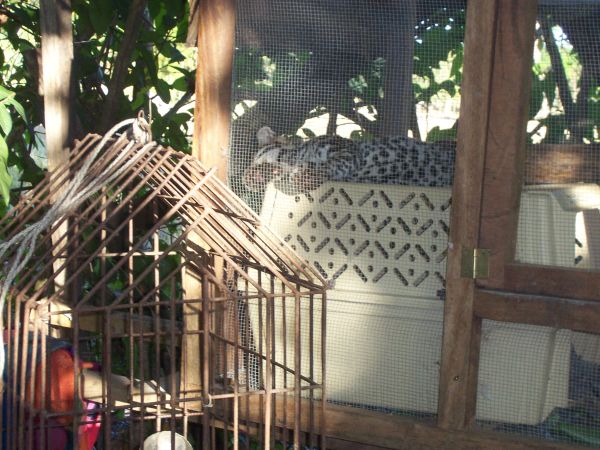
Durga growling at the iron parrot cage that was her prison before being rescued from poachers
Durga arrived at Rainsong a few months later, a baby of 2 months. Her mother had been killed by poachers for her hide, and they then kept the kitten in a bird's cage for 6 weeks, with intention to sell her as a pet.
Severly traumatized by her first encounters with humans, she remains aloof and unfriendly.
This will be good for her survival once we release her, hopefully when her kittens need to be taught how to hunt. We do not attempt to tame her in any way. We like her wild ! And it's best for her and her future children.
We are now raising wild and domestic quail and pigeons to prepare for her eventual release with babies.
She will learn how to hunt both quail and pigeons while in captivity (the foreign species), and we will have released enough breeding groups of native ones on the Sanctuary to ensure her and the kittens' survival.
We have a huge habitat designed to house both of the cats, but separately.
The location is remote and snuggled into the jungle of the Sanctuary.
We need help with the construction costs of this 7meter by 7meter habitat for our ocelots.
We are urgently looking for sponsors for this vitally important project to help us cover the costs for materials & labor. We estimate the cost for completion to be near or beyond $5000 U.S.
If you can help us with this, send us an email : MARY - HOUSE FOR CATS
Meanwhile our 2 magnificient beauties are calm and comfortable, and well-cared for.
Bambi and Rudi the Central American White-tailed Deer
June 2009
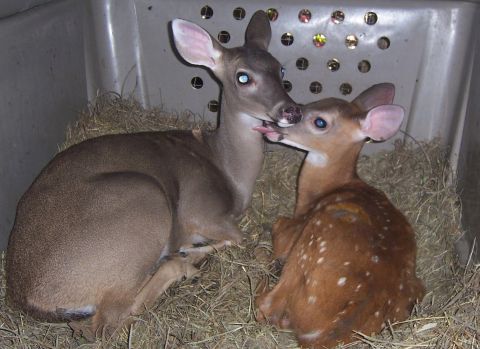
Even the deer are disappearing in our area !
Both of these beauties came to us as orphans after poachers had killed their moms.
People stumbled over the babies hidden away patiently starving to death while waiting for their
dead mothers to return.
Often poachers sell deer fawns for pets or bushmeat, when they are caught out with their
mothers.
Bambi is just 2 months older than rudi. Above, note the difference in appearance
once they drop their camouflaging spots
The central american species is quite a bit smaller than the north american species.
Bambi and Rudi now live in a large 725 square meter pen on the Sanctuary.
Since they are from very diverse areas (Bambi is from San Isidro de Malpais, and
Rudi is from Rio Negro de Cobano), we plan to let them raise a family together.
There is entirely TOO MUCH POACHING IN OUR AREA to even think about releasing
them at this point in time.
We are struggling to change local attitudes about respect for animals' rights in
the communities around our area of the Nicoya Peninsula.
Conservation Education is a priority at Rainsong.
Without a change in attitude, none of the animals and birds we release have any
chance of survival in the 21st century !
. 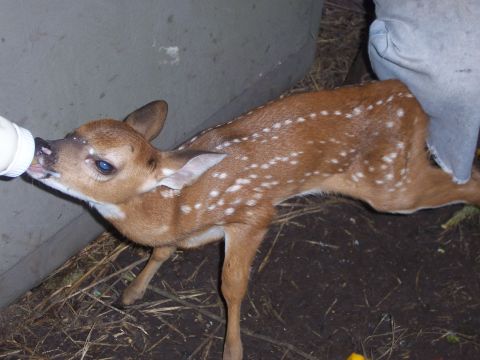
Still thin, newly arrived rudi sucks on a bottle of goat's milk for dear life !
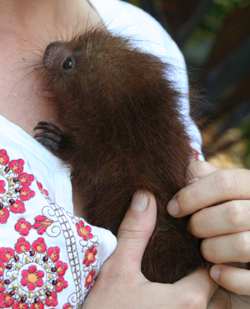 Spikey the baby Porcupine
March 2006
Spikey was found on the side of the road in Santa Teresa, by Marta Guardia, a lawyer with LLMR&T Law Firm.
Spikey's pregnant mother was hit by a car as she was running from a pack of domestic dogs. The impact caused a spontaneous abort, and only Spikey survived. Marta found the mother and another emerging twin dead in the bushes nearby. Spikey had crawled up onto the edge of the road, a tiny helpless ball of fur.
Against all odds, she was spotted and rescued by someone who knew just where to take her, and she miraculously survived. In this photo she is five days old. A couple of months later, Spikey is still small, her health stunted by being prematurely born.
Porcupines are very rare in this area, and nocturnal, so most people in the area have never seen them, although they sometimes become aware of their presence when their dogs return home with a mouthful of spines. Since Spikey was rescued, a second baby porcupine has also come to Rainsong, still with umbilical cord attached. He seems to be doing fine on a diet of goat's milk and baby formula.
PORCUPINE UPDATE - JUNE 2009
After a year of anguishing intensive care, Spikey's health finally stabilized, altho she remains stunted.
We now have a group of 4 porcupines, all brought to us as newborns with umbiical cords still attached.
We have concluded that the books are wrong...
twin births are much more common in the larger tropical mammals than before thought by the scientific community.
If the mother carries her young on her back as she traverses the canopy of the forest, she can only care for one infant, there's not room for 2 to cling to her back or belly. So, at birth, the 2nd baby is tossed from the nest.
Ginger, our 4th rescued porcupine, was actually returned to the mother's nest in a playa almendro tree on santa teresa beach, yet her mother tossed her down again.
We believe that all 4 of our porcupine babies were twins, all born a second too late.
We built a nice big porcupine habitat for all our bunch !
They are all happy and healthy, and have a tight family dynamics.
Though we'll never be allowed to release any of them, we hope to soon release them all into the jungle habitat on the Sanctuary.
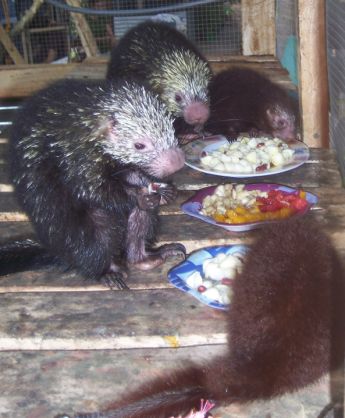
chow time! spikey, kiddo, max, & ginger
JULY 2009
Spikey suddenly died. The necropsy revealed a blackened lung and congested heart condition, possibly caused by aspiration in her infancy. She was definitely female.
We will miss her, and she is always in our prayers.
Lola the Red-Lored Parrot
MARCH 2005
Lola was the first official animal rescued at Rainsong. Mary took her away from a tica neighbor who was ignoring the poor baby bird's plaintive calls for food. Lola's foot had been broken and twisted around backwards, and her toes on one foot had been cut off. Her foot was so infected she had to go thru a series of antibiotics. She was a pitiful mess.She was missing many feathers, including all of her tail feathers.
Once rescued, she was unusually friendly and apparently
grateful for the attention and care she received at Rainsong. After several months, her feathers are growing back and she is in good spirits.
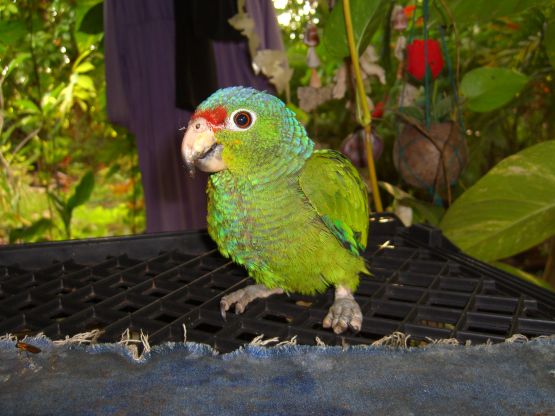
Lola after a few months at rainsong. note the mangled and still swollen left foot.
UPDATE JUNE 2009
After 3 months of physical therapy to straighten her toes out, front and back, and antibiotics to fight the infection, Lola's foot began to improve. Her toes went back to their normal position, but that foot remains weakened and her grip is precarious. This is a permanent disability.
Lola is still with us, and now has a hubbie. Red-lored parrots usually mate for life in the wild. So we were glad when a tico family gave us ChasChau to care for. His shoulder had been broken when a dog almost ate him.
They get on great together, and lola has begun keeping house in the lil nesting box in their habitat.
No eggs yet, but we're still hopeful to see some lil lolitas someday.
The continuous merciless robbing of young from nests is what wiped out the scarlet macaw and quetzal in our area over 40 years ago.
Yet the locals continue to relentlessly rob the nests of the remaining parrot species every spring.
Almost none of these tiny baby birds survive the first few days even.
Caring for infant birds is very intense and laborious. The nestrobbers aren't interested in caring for the babies, they are usually young boys with nothing better to do.
So each year, almost the whole generation is lost.
We no longer see squawking flocks of red-loreds or white-fronted parrots fill the sky.
Now if we see any at all, it's perhaps a few pairs passing overhead.
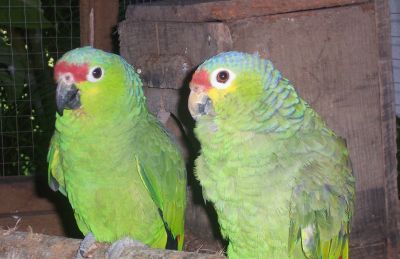
Lola and hubbie ChasChau. note Lola's left foot now has the toes in correct position.
Nipper the Baby Coati (Pizote)
APRIL 2007
Nipper was found playing in the road in Santa Teresa by Amanda of Tropisphere Real Estate. He had been taken from his mother as an infant, and his mother was probably killed in his capture. He escaped from his captors, and was confused and lost, wandering around seeking a kind soul to rescue him.
He earned his name because he likes to scratch and bite, and Mary has lost a lot of blood while caring for him. Coatis are extremely smart and although he will be released into the sanctuary, we expect that he'll hang around.
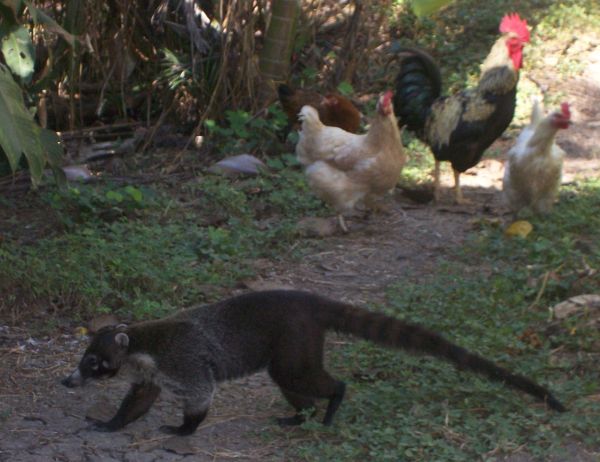
nipper on the loose at rws
UPDATE JUNE 2009
Altho we have attempted to release nipper almost 20 times into the wilderness, he always returns, often hurt. Other lone males just tear into him and he has been repeatedly wounded and comes running home. .So we have abandoned the hope that he could return to the wild as a natural pizote.
The traumas he suffered as a youngster have left him emotionally scarred and he is still unnaturally aggressive towards humans.
Nipper is the classic example of why wildlife should never be taken as pets.
Captivity renders them unsuited for any type of fulfilling life.
We are sad that we can't release nipper, we still love him even in his madness.
AUGUST 2009
Nipper got out while his habitat was being cleaned (this has happened dozens of times, no big deal),
but this time...
he stayed in the wild instead of coming back to his home.
We think he left the area of the sanctuary, because there is a large solitary male in the area, and nipper couldn't invade his territory. This larger male is probably the one who always sent nipper home all beat up.
This time nipper was smart, and took off to look for a territory of his own.
Simon has spotted a coati several times on the upper mountain of the sanctuary, who he thinks might be nipper.
This coati was playing on the tree vines, just as our nipper always did.
But he did not approach simon, and simon did not call him.
We hope this free and happy coati is our nipper gone wild !
We wish our nipper luck and blessings wherever he is !
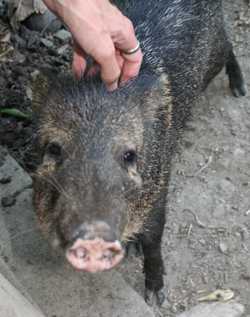 Gallo the Peccary Gallo the Peccary
AUGUST 2005
Gallo was brought to Rainsong along with his sister Pinto, both orphaned by poachers who then gave the babies to an elderly lady with a milk cow. They were about 2 months old when they arrived at Rainsong. They were both terribly emaciated from being fed only raw milk, and full of parasites. Pinto didn't survive, she died a few days after arriving.
Gallo was extremely sad and morose for many weeks, but has eventually made friends with the Rainsong dog pack, and now is as happy as can be.
Peccaries are very social animals, living in family groups whose social characteristics are more like humans even than monkeys. Males and females hold similar ranks in the family structure, and both protect the young together.
Peccaries run in groups on well-worn trails in the jungle and are therefore easily found and killed by poachers.
Peccaries are the primary prey species of jaguars, so protecting them is essential to the health of the big cats as well.
UPDATE JUNE 2009
A few years ago we renamed Gallo '
Piggle', he now lives in a large penned area with his very own mudpond. He's a happy piggle !
We are trying to locate a wife for him, but it is very dificult.
In areas where peccaries are still found in groups, they are considered a pest and are hunted without mercy, and eventually wiped out.
In our area the peccary was hunted to extinction over 30 years ago.
We still occasionally spot individuals scouting back into this territory, but the local poachers quickly kill them off.
Just last november the volunteers staying at the Sanctuary repeatedly spotted 2 orphaned youngsters raiding the compost pile at night, but they disappeared eventually, probably killed and eaten, or their meat was sold to restaurants in montezuma.
THE ELECTROCUTIONS AND POACHING ARE WIPING OUT OUR BELOVED WILDLIFE
IN COSTA RICA !!!
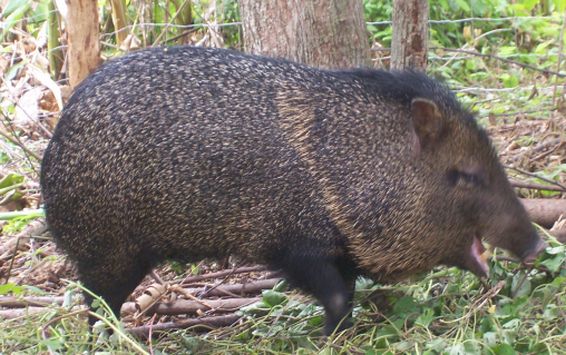
piggle's got the giggles !!!
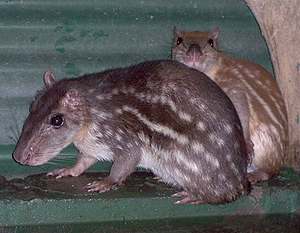 Selena the Paca
JUNE 2005
MINAE has given us permission to raise Pacas ('Tepesquintle' in Costa Rica, their Indian name) for reintroduction into the jungle.
Tepes
are a favorite quarry for poachers, so they aren't
as common as they should be. An important seed disperser, they are nocturnal, shy. and very rarely seen in the wild. We discovered that they can easily climb fences, and
can easily jump two meters high!
Selena was rescued (purchased) from a brutal breeder in Rio Grande de Paquera.
Errol jr. (as in errol flynn!), a young male, is pictured here behind selena, just after his arrival at Rainsong, after being rescued from poachers.
Poachers often capture tepes alive using hunting dogs to flush them out of their tunnels, and then carry them home in sacks.
Tepes love water, and usually have their tunnels near a creek or riverbed. Their burrow always has a back emergency door that exits close to water.
UPDATE JUNE 2009
Altho Selena and Errol jr. have had offspring, they don't get along too well.
We've had to separate them.
We need more females to effectively reproduce a viable group of young tepes for release.
This is dificult because in most areas near us they have long ago been hunted into extinction.
There are many people who raise them illegally for their delicious flesh, but we can't justify supporting this mentality by purchasing tepes from such people.
Baby Aracari
JULY 2007
This Aracari toucan was brought to Rainsong from Tambor after a wind storm blew over the tree the nest was in.
Aracaris are a small toucan. They are omnivorous (meaning they eat fruits, seeds, and also meat), eating everything from insects & lizards, to baby birds of other species.
They cannot be housed with other bird species because they will peck their eyes out, or eat them.
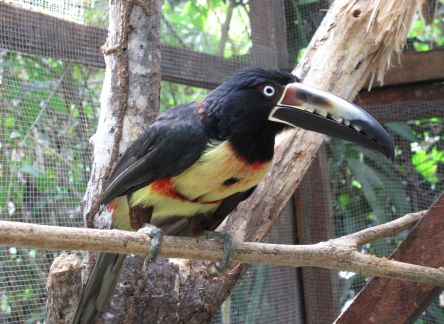
felis all grown up
UPDATE JUNE 2009
'Felis Curae' (name for this species in Chorotega tongue), is
still with us. Turns out she suffered a birth defect, the tip of her left wing bone never grew out.
Ironically, she would have certainly died in nature, yet she was the only survivor of her nest.
We're sure she's a girl because several wild aracaris come to 'chat her up' every morning.
They hang on the meshwire of her habitat and chatter away together.
Baby Squirrels
JUNE 2009
At Rainsong we have rescued numerous squirrels, releasing them once they are big enough to hold their own out in the world.
Many are still our friends and visit us often at the Rainsong quinta, and at the Rainsong Sanctuary.
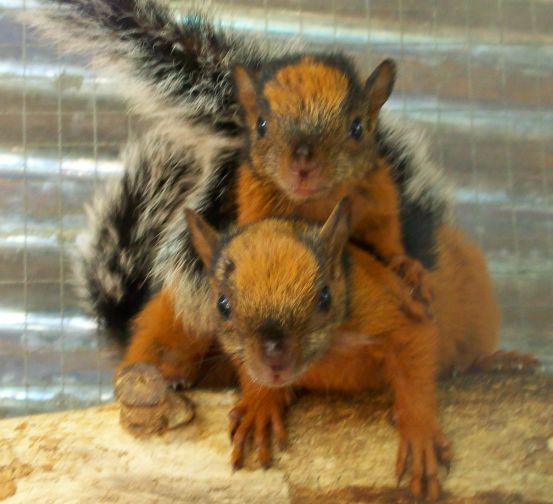
'he ain't heavy, he's my bro !'
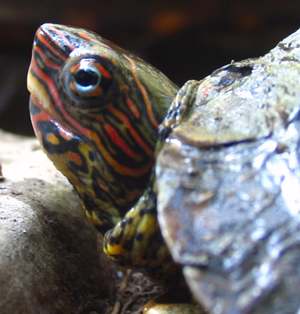 Frida the land turtle
MINAE has given Rainsong permission to start a captive breeding program for the native endangered land turtles in the area. The specimen shown on the right was found
crossing the road near Malpais / Santa Teresa. We currently have four red turtles - one male and three females, and two black turtles. Some of the red turtles have laid single eggs, which we hope will hatch into a babies to release back into the jungle. Our biologists tell us that hatching eggs from these types of turtles has never been done successfully in captivity. Turtles have become a primary prey species for large cats and other predators who don't have enough food (such as coyotes, boa constrictors, pisotis, raccoons, wildcats, etc.).
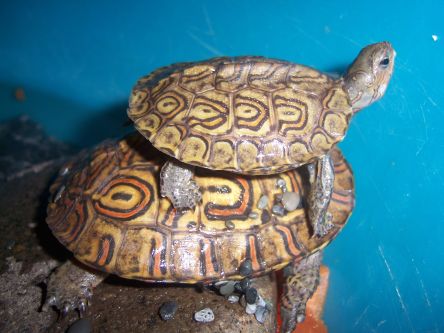
'i would get there faster if i walked !' (2 baby red river turtles)
UPDATE JUNE 2009
We now have almost 40 turtles in our reproduction garden.
So far, 12 babies have been successfully hatched from eggs laid by our turtles.
The incubation for the red-river's eggs is 4 to 5 months.
Their main enemy is ants, who ravage the eggs when discovered.
We may soon have a group of youngsters ready for release.
We'd like to prepare a large pond at the Sanctuary for them, by damming one of the small creeks.
We are raising native guppies and freshwater snails to seed the pond with.
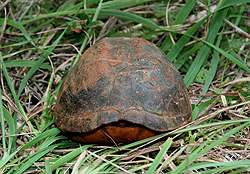 Black River Turtle Black River Turtle
This turtle was found by Amanda and Geoff of Tropisphere Real Estate and brought to the sanctuary in July 2006. It was found in a pit which had been dug for a septic tank and never used. The turtle was very light and thin and may have been there for weeks, nearly starved to death.
The scientists say a turtle can withstand up to 2 months with no water or food.
UPDATE JUNE 2009
We have lost count of the black river turtles that we have released in the past few years.
Many people bring them to us when they discover them in the roads or other high-risk areas.
We release them on the Sanctuary if they are healthy.
The black river turtle has a hinged shell which allows him to close up tight for safety against predators.
The red-river turtle lacks hinges, and so is much more vulnerable to predators.
Hence the red-river turtle is disappearing quickly, because the predators have few other prey species left to hunt.
At the Rainsong Sanctuary, we have begun to effectively repair the food chain.
Starting at the bottom with the re-introduction of turtles, iguanas, possums, skunks, and other small species that reproduce quickly, we are beginning to notice an influx of larger predators attracted by the good hunting::
recently wild ocelots have begun venturing into the Sanctuary, and our longtime resident pair of jaguarundis are often spotted darting thru the forest.
Raccoons
JUNE 2009 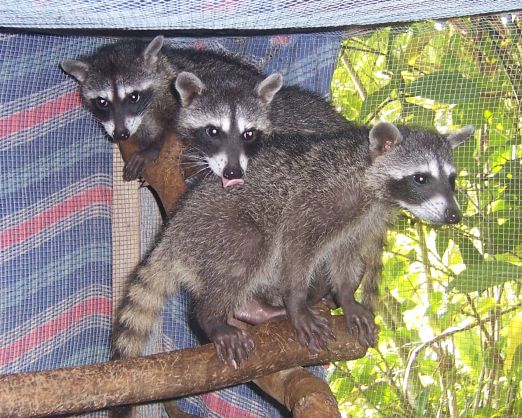
We have treated, nursed, and released numerous raccoons in the past few years, probably over 15.
We never keep them captive, if they are orphans we nurse them til they are big enough to be released.
If they are injured or sick adults, we somehow manage the care of these ferocious wild things til they can be released.
It has become common that near montezuma the people put out poison to kill these 'pests'.
We have treated and released many poisoned raccoons.
One was a lactating mother who was found disoriented and sick in front of the entrance to the montezuma waterfalls. We were called about her, so we sent a taxi with a rescue team to capture her, then we treated her for several hours at Rainsong til she recovered from the poison.
We then paid the taxi to return her, and the rescue team took her to the exact spot where
she had been picked up, and released her there. She ran around in tight circles for a few seconds, picked up her scent and took off like a rocket on her way home to her babies.
We were very pleased with the happy ending of this raccoon's terrible encounter with civilization.
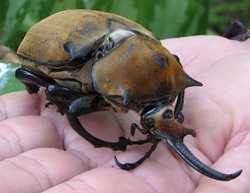 Hercules Beetles
The heaviest beetle in the world, this guy was discovered nearby. They are very rare, and we are using him to attract females. Eventually we hope that a rotting log, kept
in his cage, will become a nest for its young, which will be released into the Sanctuary. It takes a very long time for the young beetles to emerge from the log, up to 2 years !
No wonder they are so rare !
Sidewalk craftsmen covet this beetle for its horn. They use it in their jewelry to sell to tourists.
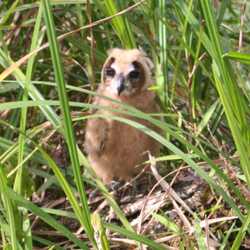 Baby Owl
2006
A baby owl with a broken wing and other unknown injuries was donated to Rainsong. After several days, he was eating well, but then one day he suddenly died, which was a very
sad day for all of us, since we had expected him to survive.
UPDATE JUNE 2009
We have cared for several owls of different species at Rainsong. Several pygmy species that had hit windshields of cars, and a few babies of larger species that had fallen out of their nest.
We have released several of these owls on the Sanctuary.
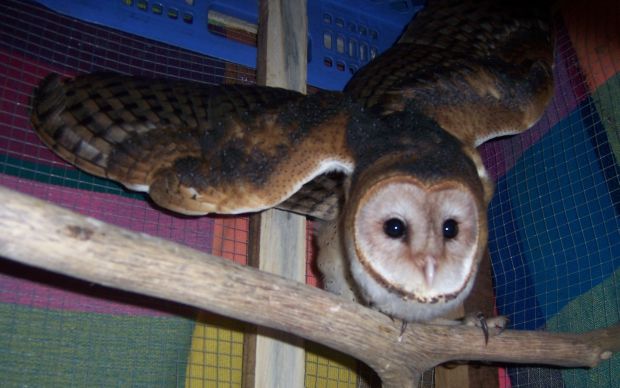 baby owl all grown up now and ready for release on the rainsong sanctuary baby owl all grown up now and ready for release on the rainsong sanctuary
 Green Iguana
2006
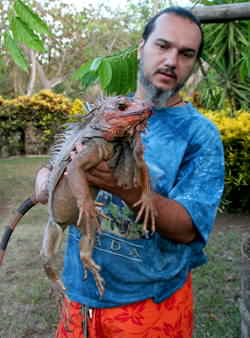
This iguana was rescued by Alberto, the owner of an Eco-Lodge Hotel in the Playa Coyote area. Cruel schoolchildren were attacking him with rocks, and
he was bleeding from his eyes and mouth. Despite his ghastly internal bleeding, he seemed to be able to keep his balance, and was able to move around a bit. We didn't have much hope that he would survive, but iguanas are very tough animals. We thought that if we can keep enough water and food in him, then perhaps he will heal. We also fed him fruits, lettuce and other veggies that were blended with watermelon juice, using a syringe with a nipple attached. At first he resisted, but later he seemed more eager to be fed. Many injured animals die simply from dehydration. He seemed to be recovering, although it was obvious that he was blind due to damage to his head. After a little over a week, he died despite all our efforts.
UPDATE 2009
We have been working in the re-introduction of several iguana species over the last few years on the Rainsong Sanctuary.
We rescued young iguanas at friends' places near the beach, where they become pests.
We released all these rescued iguanas at rainsong, and now we have a very healthy population on the rainsong sanctuary, where there were none before.
The ticos still kill the iguana on sight. Long ago, they were killed to be eaten. Nowadays it's often just for devilish 'fun', and we have had numerous iguanas brought to the rescue center after being mercilessly stoned by children.
To date, we have been unable to save any of these injured iguanas, despite all our earnest efforts.
 Royal Tern Royal Tern
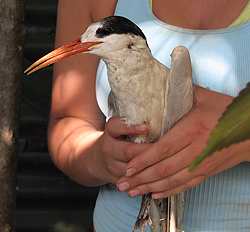
This injured bird is called a Royal Tern. They are a migrant bird that comes to our area of Costa Rica around Sept-Dec and typically fish at rivermouths. This one had to
be force-fed with a bottle.
It was set free after a few days of nursing.
|

